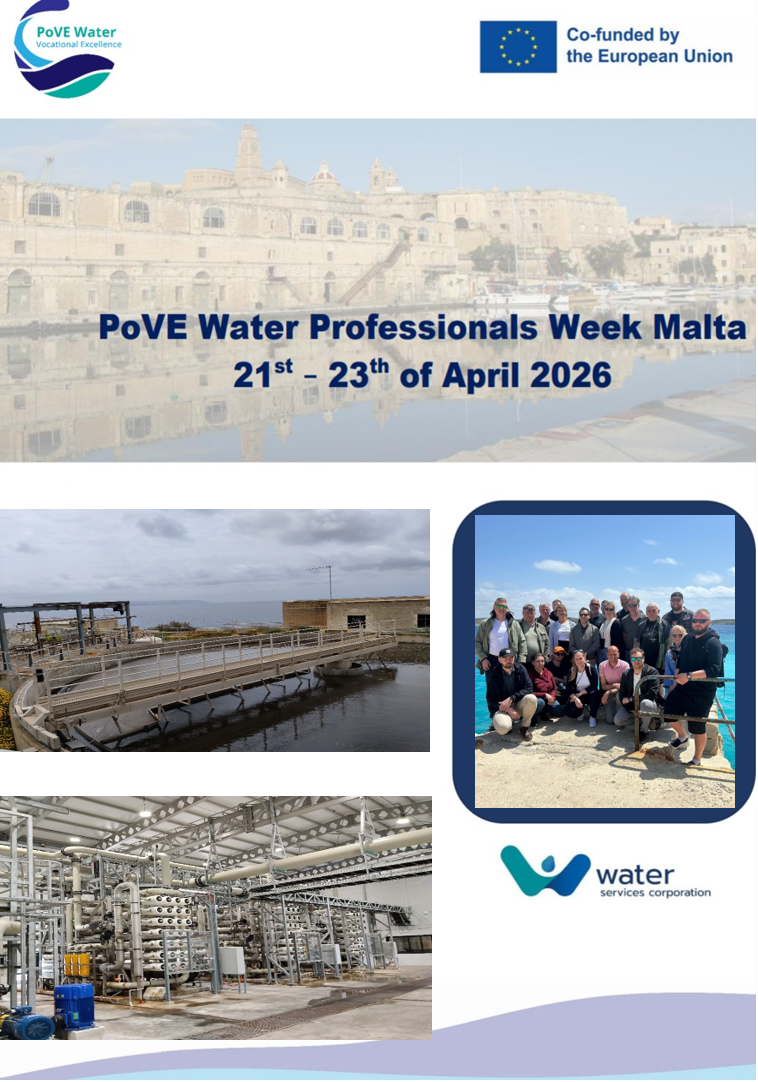
While Malta is a wonderful island to visit for a tourist, it makes a water specialist think differently: there is little fresh water, groundwater is slowly being replenished, and at the same time, all life – residents, agriculture and tourism – relies on a reliable water supply. Malta and Gozo offer an outstanding example of how a country with very limited fresh water resources has managed to build a functioning and innovative water management system.
A study tour organised by the Malta Water Services Corporation (WSC) within the framework of the PoVE Water project gave water specialists from several European countries a first-hand overview of drinking water production, wastewater treatment and water reuse in complex geological and climatic conditions. Participants Martin (AS Kuressaare Veevärk), Ragnar (AS Tallinna Vesi), Valter (Tapa Vesi OÜ) and Ivar (Järvamaa RK) summarised their experiences as follows:
Reflections from an International Study Visit
Malta and Gozo offer a compelling example of how a country with extremely limited freshwater resources has built a resilient and innovative water management system. A study visit to the islands provided participants from several European countries with first-hand insight into how drinking water production, wastewater treatment, and reuse are implemented under challenging geological and climatic conditions.
Limited Natural Resources, Innovative Solutions
Unlike Northern Europe, Malta has very limited and slowly renewing groundwater reserves. Seawater intrusion affects aquifers, resulting in naturally high groundwater salinity by Nordic standards—around 3,000 µS/cm—requiring additional treatment before use. As a result, the majority of Malta’s drinking water is produced through seawater desalination.
Today, approximately 70% of potable water comes from desalinated seawater and 30% from groundwater, blended to ensure stable quality and supply. Seawater used in desalination has a salinity of around 55,000 µS/cm, while the concentrated brine returned to the sea reaches about 80,000 µS/cm.
Seawater Desalination and Energy Efficiency
Participants visited several reverse osmosis (RO) water production plants, including both Malta’s oldest and newest facilities. The plants use high-pressure reverse osmosis, where roughly 40% of the intake water becomes drinking water and 60% is discharged back to the sea as concentrate.
A particularly interesting feature is how seawater is abstracted: instead of open intakes, water is drawn through boreholes drilled into coastal rock formations, where natural rock porosity acts as a first-stage mechanical filter. This significantly reduces pre-treatment needs and improves overall process reliability.
Energy efficiency is a critical factor in such systems. Malta has invested heavily in energy recovery systems, allowing up to 98% of the energy used to create pressure for the RO process to be recovered and reused. This substantially lowers operational costs and energy demand—an essential consideration for island states with limited energy resources.
Water Losses, Pricing, and Scale
Malta has achieved impressive results in reducing water losses in the distribution network. Current non-revenue water levels are around 9%, with a target of 6–7%, which operators consider an economically optimal lower limit.
Despite its limited resources, water remains affordable. The drinking water price in Malta is approximately €1.40 per cubic metre, and wastewater services are reportedly included without a separate charge.
For comparison, the entire Maltese archipelago is roughly twice the size of Tallinn, yet it is home to about 580,000 permanent residents, plus a very large number of tourists year-round—placing continuous pressure on water infrastructure.
Wastewater Treatment and the “New Water” Concept
A key highlight of the visit was wastewater management, particularly on Gozo, where participants toured the Gozo Wastewater Treatment Plant. One major challenge discussed was agriculture-related pollution, especially manure entering the sewer system. To address this, the wastewater operator purchases manure from farmers and redirects it into compost production, reducing the load on treatment processes.
Malta has taken wastewater reuse a step further with its “New Water” project. Highly treated wastewater—purified to near drinking-water quality—is reused primarily for agricultural irrigation. This significantly reduces groundwater abstraction and helps preserve precious freshwater resources for drinking water production.
For farmers, the system is economically attractive: the annual fee for reclaimed water is approximately €25, regardless of consumption volume.
Knowledge Sharing and International Cooperation
The study visit brought together participants from Estonia, Denmark, Latvia, Czechia, and Malta. Workshops and group discussions revealed that many water-sector challenges—such as aging infrastructure, climate impacts, and resource efficiency—are shared across countries, even though local solutions differ. For example, in some regions, rainwater harvesting is legally required, while in Malta it is a historical necessity.
In addition to technical visits, cultural excursions in Valletta and Victoria (Gozo) provided valuable context for understanding how water management is closely linked to Malta’s history, urban form, and way of life.
Key Takeaways
The visit clearly demonstrated how a well-organized water sector can function effectively even under extreme resource constraints. Malta’s experience shows that:
Desalination can be viable and energy-efficient at national scale
Groundwater protection and wastewater reuse are essential complements
Investment in efficiency, innovation, and reuse pays off both economically and environmentally
Although the facilities themselves were smaller than initially expected, their performance and integration into a national system made a strong impression. The experience reinforced the value of international learning and practical, on-site knowledge exchange in addressing future water challenges.